
Stranded in Paris with Basic French
Missing the last train to Versailles.

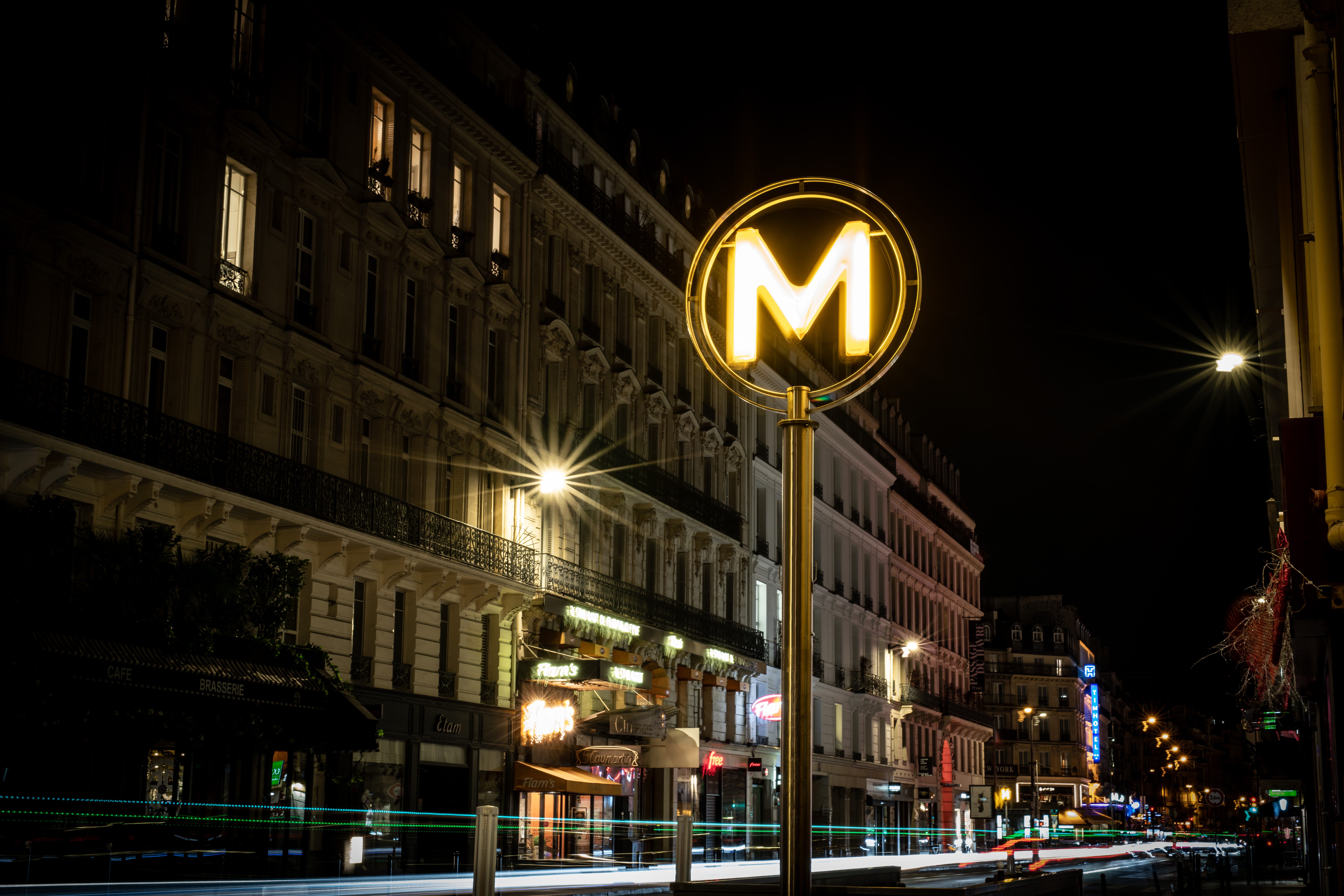
The last train to Versailles would leave Paris at 1:00 a.m. I left the cozy eatery where I had dinner and drinks with my friend around midnight. It should’ve been enough time to make the last train. Should’ve been.
I’ve noticed that something funny happens to the trains the later it gets in Paris. Lines close inexplicably and with no warning. Like a server at a café who mysteriously disappears, they just stop working. Like a server at a café, trains are there to do a job. They may even be pleasant at times. But they don’t owe you anything. They’re not there to cater to your every whim. If you don’t manually open the train car doors, for instance, you’ll be staring at metal while your train leaves without you. Unlike servers, however, there’s no replacement coming.
I never know why a line has closed. Maybe there’s a strike that started at 11:14 p.m. Maybe it’s windy. Maybe the train thinks the crowd looks a bit frowsy. All I know is that when that happens, it’s time to leave the platform and exit the station in search of uncharted stations with exotic lines that terminate one stop away. Thank goodness for maps apps because navigating the Paris Métro at night without any help would be quite a test of one’s mettle.
I was going to let Apple Maps guide me that night too, until I noticed something peculiar: It was recommending buses and, when the buses ran out, car services. Finally, it dawned on me: There were no more trains to Versailles.
I became acutely aware of the ubiquitous French surrounding me. Usually, I let it in. Test my comprehension. Pick out words or phrases I know. The French I heard was no longer composed of distinctive timbres and cadences but rather a strange susurrating mass. A wall with a few small windows but no door.
That’s OK, I thought. I’ll just hop on a train going west, get as close to Versailles as possible, and get a car from there. I didn’t want to pick up a taxi where I was because a car from the center of Paris can be expensive depending on the time of day and traffic. It’s about 12 miles from central Paris to Versailles. With the benefit of hindsight, I should’ve considered what the stop would be like.
The last stop wasn’t shady. It just wasn’t conducive to getting a taxi. There was a main thoroughfare, a big parking lot where the stop let in, and a few dormant commercial buildings. There was some through-traffic, but nowhere convenient to stop. As proof of its inadequacy, there wasn’t another pedestrian in sight.
I opened up the Uber app, but it wasn’t working. For some reason, it couldn’t load my profile. I tried the G7 app, the app for Paris taxis, but it said my credit card information was out of date. That’s OK, I’ll just plug in the—nope, didn’t let me do that either.
I started to consider other options. Could I walk from here? I checked the map. I was still five or six miles away. It wouldn’t be pleasant, especially at this time of night, but I could make that walk in a couple of hours. The question wasn’t whether I could but rather whether I should. What if I had to walk through a sketchy area? I would be an easy target, with my little scarf and pea coat, plus, you know, the consummate lack of French. Or what if my battery died? I would be lost and without my only lifeline in a foreign country: Daniela, my wife.
Just as I was enlisting Daniela in the coordination of my rescue, I managed to get the Uber app to work. A car was on its way. My misadventure had come to an end. The car showed up ten minutes later.
“Pour Pablo?” I asked, which I knew was a stupid question, given there wasn’t a pedestrian within two square miles.
“Oui.”
I got in the car and relaxed. The hard part was over. After ten minutes or so, I checked the map to see how much longer I had to go. Something was wrong.
“Excusez-moi,” I said as calmly as possible. “A Versailles?”
“Non,” he started before peppering me with French I didn’t understand.
I looked at the app. I was heading toward Parsons Paris, my wife’s former graduate school. I must have saved it as one of my favorites and, in my rush to get the hell out of Dodge, clicked on it by accident. I was heading back toward the center of Paris.
“Pouvez-vous aller a Versailles?” (Can you go to Versailles?”)
He shook his head, but I wasn’t sure if that was the right way to ask or if I’d butchered the pronunciation such that he didn’t understand me. I punched the question into Google Translate and showed it to him. He shook his head.
He pulled over and let me out.
“Désolé” (I’m sorry), he said.
I wanted to say, “Can you please help me out here? I know Versailles is far, but I don’t know how else I’ll get home. I’m American, so you know I’ll give you a good tip. I’ll make it worth your while. What do you say?”
But all I could muster was, “Je comprends” (I understand). I didn’t.
I was a little bit farther, a little bit poorer, and with less battery charge. I started to make the same calculations I had 15 minutes earlier when I spotted a taxi parked in front me, just 30 yards away.
I walked up to the driver’s-side window and waved. The driver rolled down the window.
“A Versailles? C’est bon?” I asked.
“Oui,” he said.
“Merci beaucoup!”
I got in the taxi and read him the address. He punched it in and we were off. He spoke a little English and a little Spanish. A barebones pidgin mix of the three languages made for an interesting ride home. He was a nice guy and curious.
“You are here for vacances, eh, holiday?”
“No, j’habite a Versailles with my wife, ma femme.”
“You live in Versailles?”
My insecurity interpreted that to mean, “How could you live here and speak such dogshit French?”
“We’ve been here two months,” I added.
“Months?”
“Deux mois,” I said. My wife is étudiante a ISIPCA.”
“Ah,” he said, starting to understand.
When he dropped me off right in front of our apartment building, I thanked the driver profusely and left him an American-sized tip.
“Merci beaucoup!” I repeated. It was no longer a translation of the English “thank you very much.” It became its own thing that night.
It was late, but my wife was still up, probably as anxious as I was. She’d heard part of what had happened, but I filled her in on the rest. My extended detour was quickly turning into a story, the prototype of the one I’m telling right now.
I wasn’t stranded in Paris. I was fine. But I did realize something. I had gotten complacent. I had gotten used to going to the grocery store, the local convenience store, or the boulangerie and repeating the same set of words and phrases. I had just enough French words to get what I needed. I clung to those few words like a raincoat in a storm. But when I had to solve a problem, my French proved woefully deficient.
That night reminded me that language isn’t just a convenience. It’s safety. It’s navigation. It’s your defense. Without it, you’re at a keen disadvantage, and in the wrong situations, you can be compromised, even put in danger.
And yet, being lost and failing in French was good for me. The urgency removed all insecurity about my French. It forced me to take chances, searching for the words that would deliver me home. French was no longer a dalliance or a luxury I dabbled in to procure baked goods. It was suddenly a tool, however limited, that I used to get home.
I won’t be able to improve my French if I tread the same paths over and over, repeating the same phrases. I have to wade into uncomfortable situations. I have to be OK with messing up. I can’t always follow the GPS. I have to get lost.
You were so determined. I would have freaked out. 👏🏽👏🏽
Man, I'm glad you made it home safely and it didn't turn into some real life Taken situation. Your observation of suddenly needing more of an unfamiliar language than usual is important. I've run out of the little bit I know in places and spaces where I could have done with more. Like you, I had some kind soul compassionate enough to meet me halfway or more to help me out.
No situation is guaranteed to have a good Samaritan bailing you out. It makes me appreciate people in the US even more who have English as a second language, who frequently accomplish so much more than I can in another tongue.